 Products Home
IRsweep Dual-Comb Spectrometers
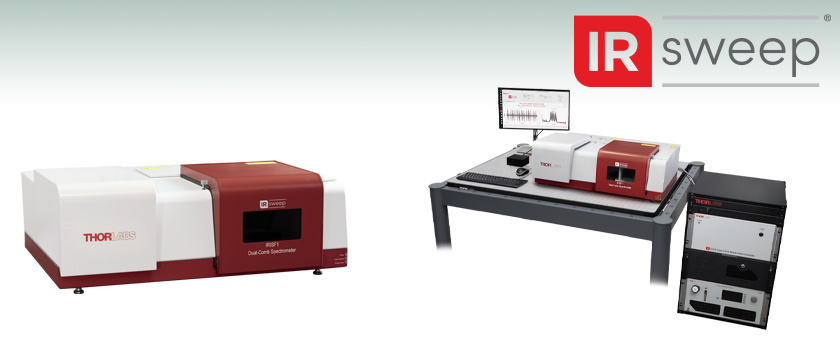
- Turnkey Mid-IR Spectrometer in the Molecular Fingerprinting Region
- User-Exchangable Laser Modules to Cover Multiple Spectral Bands
- ~4 μs, ~0.5 cm-1 Time and Spectral Resolution for an Up to 32 ms Window
- Sources Available from 1800 cm-1 to 1000 cm-1 (5.6 - 10.0 μm)
Application Idea
An IRsweep Spectrometer on a Rigid 3' x 4' (900 mm x 1200 mm) ScienceDesk (ScienceDesk Available Separately)
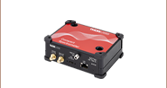
IRsweep Dual-Comb QCL Spectrometer, Amplitude Sensitive



Please Wait
| Table 1.1 Key Specificationsa | |||
|---|---|---|---|
| Parameter | Specification | ||
| Time Resolution | ~4 µsb | ||
| Laser Module | User-Exchangable Quantum Cascade Laser Dual Frequency Comb Source | ||
| Laser Module Center Wavelengthsc | 1800 cm-1 (5.6 µm) 1265 cm-1 (7.9 µm) 1055 cm-1 (9.5 µm) 1000 cm-1 (10.0 μm) |
||
| Spectral Coverage | 10 cm-1 to 60 cm-1 (Varies with Laser Module)d | ||
| Spectral Resolution (Standard Mode) |
~0.5 cm-1 (15 GHz) | ||
| Spectral Resolution (High-Res Mode)e |
~0.0003 cm-1 (9 MHz) (Linewidth of a Single Comb Line) |
||
| Spectral Point Spacing (Comb Line Spacing) | 0.165 cm-1 - 0.5 cm-1 (5 to 15 GHz) (Depending on Center Wavelength and System Settings) |
||
| Dimensions | 770 mm x 571 mm x 281 mm (30.3" x 22.5" x 11.0") |
||
| Weight | 80 kg (176 lb) | ||

Reza Salem
BU Leader
Laser Systems and Technology

Features
- Standard Resolution: ~0.5 cm-1 (15 GHz) at ~4 μs per Spectrum
- As Low as ~1 µs with Manual Post-Processing
- External Triggering Available
- High Resolution: ~0.0003 cm-1 (9 MHz) at ~1 hr per Spectrum
- Requires Stepsweep Laser Module
- User-Exchangeable Dual Quantum Cascade Laser Frequency Comb Modules
- 10 cm-1 to 60 cm-1 (0.3 to 1.8 THz) Typical Bandwidth per Module (Varies with Laser Module)
- Modules Available from 1800 cm-1 to 1000 cm-1 (5.6 to 10.0 μm)
- Thermoelectrically Cooled Mercury Cadmium Telluride Detectors
- Sample Chamber with Internal Breadboard Supports Custom Setups
- Beam Can Be Coupled to External Experiments
- Nitrogen or Dry Air Purging
Applications
- Fingerprint Region Molecular Spectroscopy
- Chemical Kinetics and Dynamics
- Photocatalysis
- Protein Dynamics
- Stopped-Flow Spectroscopy
- Spectroelectrochemistry
- Combustion Studies
- Shock Tube Spectroscopy

Click to Enlarge
Figure 1.3 High-Resolution Stepsweep Spectrum of a Methane Peak and a Gaussian Fit to the Doppler-Limited Lineshape (Wavenumber Axis Calibrated to HITRAN Data)

Click to Enlarge
Figure 1.2 The Sample Compartment of an IRsweep Spectrometer with a Methane Gas Sample Installed
The IRsweep Dual-Comb Quantum Cascade Laser Spectrometers enable time-resolved, mid-infrared spectroscopy in the molecular fingerprint region in turnkey, easy-to-use instruments. Made possible via a license and technology transfer, the patented dual-comb measurement technique employs user-exchangeable quantum cascade laser (QCL) pairs producing frequency combs, which are optical rulers in frequency space with an equal distance between each comb line. These broadband sources have spectral bandwidths from 10 cm-1 to 60 cm-1 (0.3 to 1.8 THz), and we offer center wavelengths in the mid-infrared from 1800 cm-1 to 1000 cm-1 (5.6 to 10.0 μm) with a standard spectral resolution of ~0.5 cm-1 (15 GHz) at ~4 µs per spectrum. For a simple explanation of dual-comb spectroscopy, see Figure 1.4.
A high-resolution mode is accessible using the Stepsweep versions of our laser modules, which allows spectra to be acquired with a resolution as fine as the linewidth of one comb tooth, ~0.0003 cm-1 (9 MHz). At the expense of longer acquisition times, the high-resolution mode is ideal for resolving detailed spectral structure in gas-phase samples, as shown in Figure 1.3 (see the Example Spectra tab for the full spectrum and other sample spectra).

Click to Enlarge
Figure 1.4 Dual-comb spectroscopy is performed by superimposing two optical frequency combs with different mode spacings and then sending them both through a sample. High-speed detection converts the optical spectrum to the radio frequency regime, thus recovering the optical absorption spectrum of the sample. Please see the Dual-Comb Basics tab for background details on dual-comb spectroscopy and a description of the two different options: Amplitude Sensitive (shown here) and Phase Sensitive. Note that high-resolution mode is only available with the Phase Sensitive version and a Stepsweep laser module.
The broadband frequency combs allow for fast, simultaneous observation of multiple spectral peaks, making detection and tracking of multiple species or the evolution of a species within a sample possible. Spectra are recorded sequentially in just ~4 μs each with superior signal-to-noise compared to traditional Fourier transform infrared (FTIR) spectrometers, enabling time-resolved fingerprint region spectroscopy. For a more in-depth comparison to rapid-scan and step-scan FITR spectrometers, please see the Dual-Comb Basics tab. The IRsweep spectrometer can be integrated into a dynamic experiment using an external trigger in time-resolved mode (see the Operation tab for details on the modes of operation).
IRsweep Spectrometer
The IRsweep spectrometer is a turnkey instrument in a benchtop form factor. With an integrated and enclosed sample compartment, shown in Figure 1.2, the spectrometer fully contains the experimental setup and shields the beamline from source to detection for a safe, easy-to-use instrument. The large 270 mm x 270 mm x 175 mm (10.6" x 10.6" x 6.9") sample compartment with an integrated breadboard allows for coupling to many existing accessories such as attenuated total reflection (ATR) units, transmission cells, and reflection setups. The beams can also be sent outside the sample chamber to an experimental setup on the optical table that requires more room than available in the sample chamber. The exchangeable laser modules can be purchased in four different standard wavelengths listed in Table 1.1; if you are interested in purchasing a custom center wavelength IRsweep laser module, please contact us.
The pair of high-bandwidth and high-sensitivity, thermoelectrically-cooled, mercury-cadmium-telluride detectors allows for fast data acquisition and does not require liquid nitrogen cooling. Standard spectral acquisition time is ~4 μs, with the ability to go down to ~1 μs with manual post-processing. Spectra are acquired sequentially with no downtime between acquisitions. This continuous acquisition results in a single integrated measurement block of up to 32 ms composed of as many as 32 500 sequentially measured spectra, providing insight into reaction dynamics on the microsecond timescale. Due to recording individual spectra on the microsecond timescale rather than integrating continuously, shot-to-shot changes like photobleaching, baseline shifts, and thermal effects can be monitored. With time-resolved and long-term measurement modes available (see the Operation tab for details) measurement blocks can be recorded with good signal-to-noise for time-resolved spectroscopy from the millisecond to the hours regime.
| IRsweep Spectrometer Specificationsa | |||
|---|---|---|---|
| Spectrometer | |||
| Time Resolution | ~4 µsb | ||
| Laser Module | User-Exchangable Quantum Cascade Laser Dual Frequency Comb Source | ||
| Laser Module Center Wavelengthsc,d | 1800 cm-1 (5.6 µm) 1265 cm-1 (7.9 µm) 1055 cm-1 (9.5 µm) 1000 cm-1 (10.0 μm) |
||
| Spectral Coverage per Source | 10 cm-1 to 60 cm-1 (Varies with Laser Module)e | ||
| Spectral Resolution (Standard Mode) |
~0.5 cm-1 (15 GHz) | ||
| Spectral Resolution (High-Resolution Mode)f |
~0.0003 cm-1 (9 MHz) (Linewidth of a Single Comb Line) |
||
| Spectral Point Spacing (Comb Line Spacing) |
0.165 to 0.5 cm-1 (5 to 15 GHz) (Depending on Center Wavelength and System Settings) |
||
| Dimensions | 770 mm x 571 mm x 281 mm (30.3" x 22.5" x 11.0") |
||
| Dimensions of Sample Compartment | 270 mm x 270 mm x 175 mm (10.6" x 10.6" x 6.9") |
||
| Weight | 80 kg (176 lb) | ||
| Power Supply Control Unit | |||
| Voltage | 100 - 240 VAC, 50/60 Hz | ||
| Power Consumption | 540 VA (Typ.) | ||
| Purge Gas Supply | |||
| Purse Gas Properties | Air or Nitrogen Gas, Dry (Dew Point Below -40 °C) and Clean (Oil-Free and Dust-Free) | ||
| Max. Pressure | 2.0 bar | ||
| Recommended Flow Rate | 200 L/h (Not More Than 500 L/h) | ||
| Fitting | 4 mm OD Tube | ||
| External Trigger | |||
| Connector | SMA | ||
| Signal | Rising Edge Signal in the Range of -0.5 to 3.3 V | ||
| Environmental Conditions for Ideal Operation | |||
| Ambient Temperature Range | 18 to 30 °C | ||
| Ambient Temperature Fluctuations | 1 °C/Hour (Max) and 2 °C (Max) | ||
| Relative Humidity | ≤80% (Non-Condensing) | ||
IRsweep Spectrometer Panels

Click to Enlarge
Figure 3.2 IRsweep Spectrometer Back Panel
Click to Enlarge
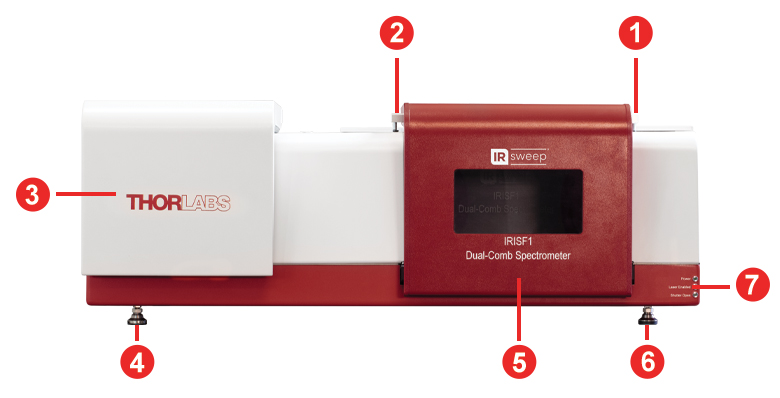
Figure 3.1 IRsweep Spectrometer Front Panel
| Spectrometer Back Panel | |
|---|---|
| Callout | Description |
| 1 | Cooling Fluid Circuit Connection Output from Spectrometer to Chiller (Labelled OUTLET) |
| 2 | Cooling Fluid Circuit Connection Input from Chiller to Spectrometer (Labelled INLET) |
| 3 | Dry Air or Nitrogen Purge Gas Input to Sample Chamber |
| 4 | Dry Air or Nitrogen Purge Gas Input to Instrument |
| 5 | AC Detector Signal Output for Sample (A) |
| 6 | AC Detector Signal Output for Reference (B) |
| 7 | 12 VDC Power Supply Input with Protective Grounding from Metal Housing |
| 8 | Laser Current |
| 9 | Laser Temperature Reading |
| 10 | Laser Peltier Current for Laser Temperature Control |
| 11 | Laser Status Interlock BNC Connector Open: Lasers Off, Closed: Lasers On (Connect to Laser Status Monitor) |
| 12 | Ethernet Communication Bus Between Spectrometer and Control Electronics Box |
| Spectrometer Front Panel | |
|---|---|
| Callout | Description |
| 1, 2 | Push-Pull Buttons to Override the Interlock Mechanism |
| 3 | Laser Module Compartment |
| 4, 6 | Four Spectrometer Feet Support the Weight |
| 5 | Sample Compartment |
| 7 | Status Indicator LEDs Power: Indicates Mains Power Supply is On Lasers Enabled: Indicates Current to the Lasers is Enabled and Laser Radiation is Present in the Optical Unit Laser Interlock Disabled: Indicates the Interlock Mechanism has been Overridden |
Click to Enlarge
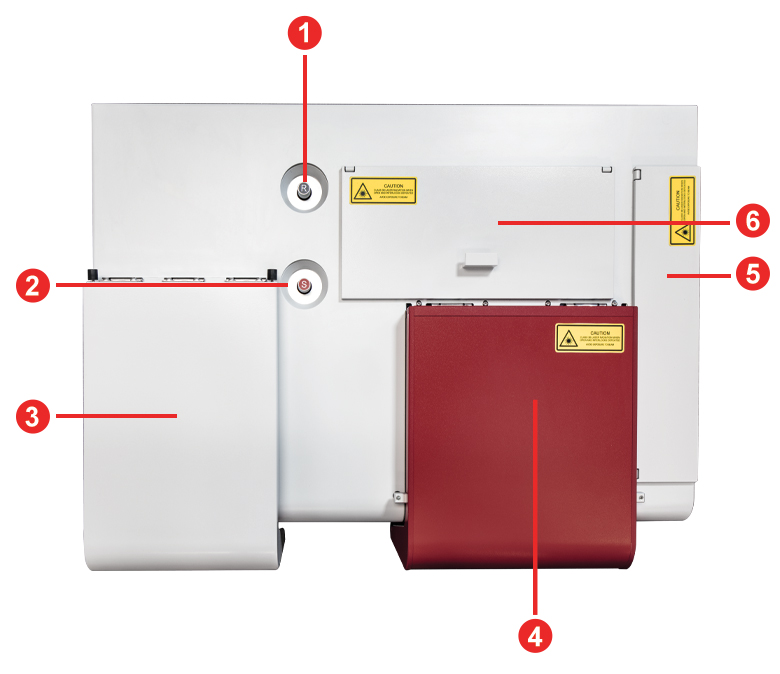
Figure 3.3 IRsweep Spectrometer Top Panel
| Spectrometer Top Panel | |
|---|---|
| Callout | Description |
| 1 | Reference Beam Polarizer Adjuster for Laser Power |
| 2 | Sample Beam Polarizer Adjuster for Laser Power (ASC Version Only) |
| 3 | Laser Module Compartment |
| 4 | Sample Compartment |
| 5, 6 | Access Panels to Maintenance Areas |
IRsweep Laser Module Panels
Note that there are three different types of laser modules that can be purchased, with four different wavelength options. The amplitude-sensitive and phase-sensitive versions of the IRsweep Spectrometer have different laser module designs, plus there is an additional option for the Stepsweep laser module to allow high-resolution mode, which is only available for the phase-sensitive version.
Click to Enlarge
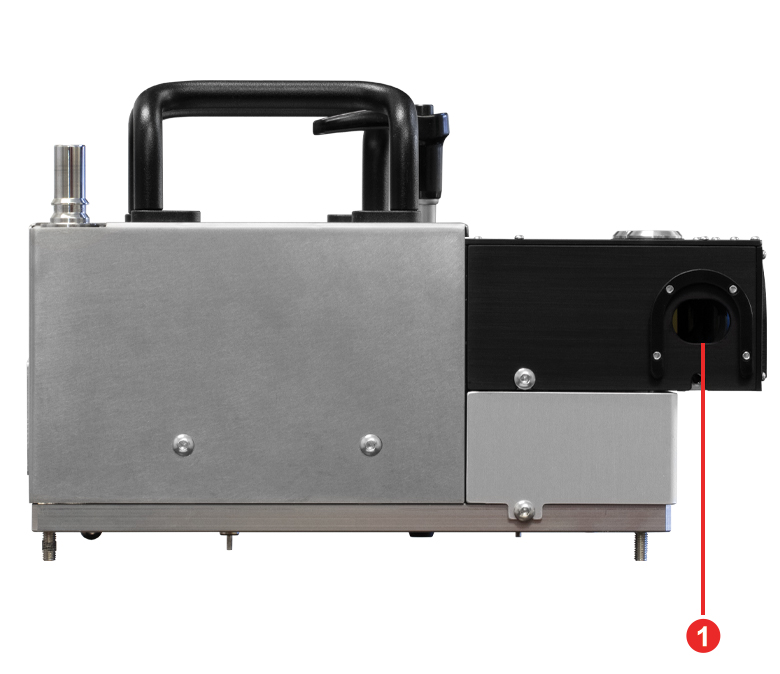
Figure 3.5 IRsweep Laser Module Side Panel
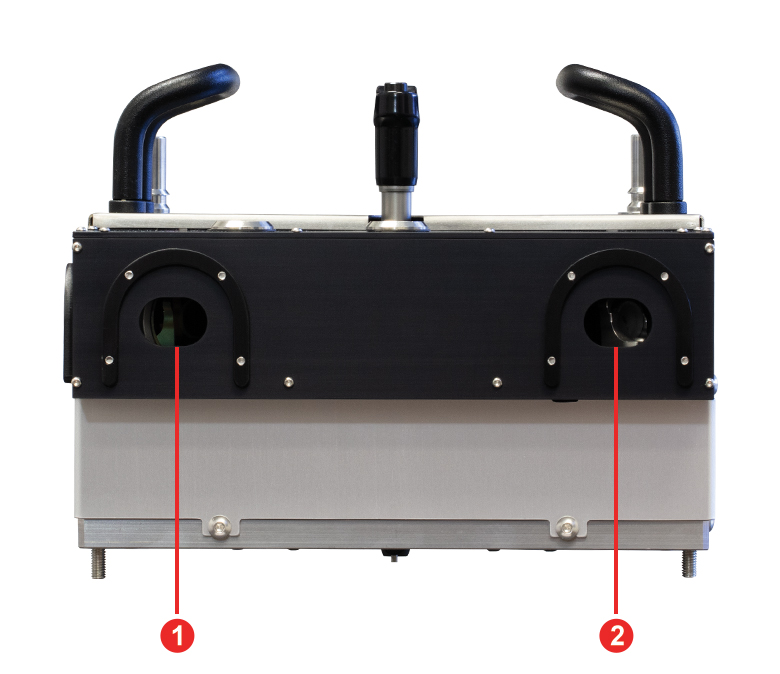
Click to Enlarge
Figure 3.4 IRsweep Laser Module Front Panel
| Laser Module Side Panel | |
|---|---|
| Callout | Description |
| 1 | Laser Emission Aperture (Emission for Amplitude-Sensitive Versions Only) |
| Laser Module Front Panel | |
|---|---|
| Callout | Description |
| 1 | Laser Emission Aperture (Emission for Amplitude-Sensitive and Phase-Sensitive Versions) |
| 2 | Laser Emission Aperture ( Emission for Phase-Sensitive Versions Only) |
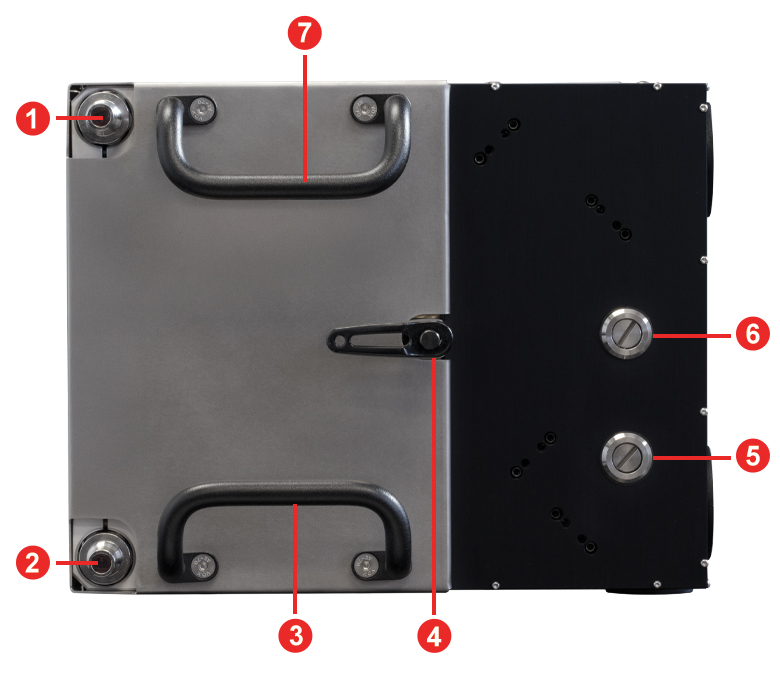
Click to Enlarge
Figure 3.6 IRsweep Laser Module Top Panel
| Laser Module Top Panel | |
|---|---|
| Callout | Description |
| 1, 2 | Coolant Connectors (No Polarity) |
| 3, 7 | Handles for Lifting the Laser Module During Exchange |
| 4 | Locking Latch with Button (for Locking/Unlocking Laser Module) |
| 5 | Laser 2 Beam Shutter (Only Functions for Amplitude-Sensitive Version) |
| 6 | Laser 1 Beam Shutter (Only Functions for Amplitude-Sensitive Version) |
IRsweep Control Electronics Rack Panels

Click to Enlarge
Figure 3.8 IRsweep Control Electronics Rack Back Panel

Click to Enlarge
Figure 3.7 IRsweep Control Electronics Rack Front Panel
| Control Electronics Rack Back Panel | |
|---|---|
| Callout | Description |
| 1 | Ethernet Switch |
| 2 | Multi-Plug Adapter Outputs |
| 3 | Back Panel of Laser Control Electronics Box (See Figure 3.9) |
| 4 | Back Panel of Acquisition Computer (See Figure 3.10) |
| 5 | LK500 Rack-Mounted Chiller AC Power Inlet / Fuse Drawer |
| 6 | LK500 Rack-Mounted Chiller 1/4" Hose Barb Valved Panel Mounting Coupling Insert for Coolant Out |
| 7 | LK500 Rack-Mounted Chiller 1/4" Hose Barb Valved Panel Mounting Coupling Insert for Coolant Out |
| Control Electronics Rack Front Panel | |
|---|---|
| Callout | Description |
| 1 | Multi-Plug Adapter Power Switch |
| 2 | Multi-Plug Adapter Fuse |
| 3 | Laser Control Electronics Box Power Indicator LED (Green: Main Power Switch On) |
| 4 | Laser Control Electronics Box |
| 5 | Acquisition Computer |
| 6 | LK500 Rack-Mounted Chiller Coolant Filler Cap |
| 7 | LK500 Rack-Mounted Chiller Liquid Level Indicator |
| 8 | LK500 Rack-Mounted Chiller Standby Power Button |
| 9 | LK500 Rack-Mounted Chiller 5" TFT Touchscreen |
| 10 | LK500 Rack-Mounted Chiller RUN / STOP Button |
| 11 | LK500 Rack-Mounted Chiller Rotary Knob |
| 12 | LK500 Rack-Mounted Chiller 5 Dynamic Side Menu Buttons |
| 13 | Compartment with Acquisition Computer Power and Reset Switches and USB Ports |
| 14 | Laser Key Interlock, Vertical/OFF: Lasers Cannot be Enabled, Horizontal/ON: Lasers Can be Enabled |
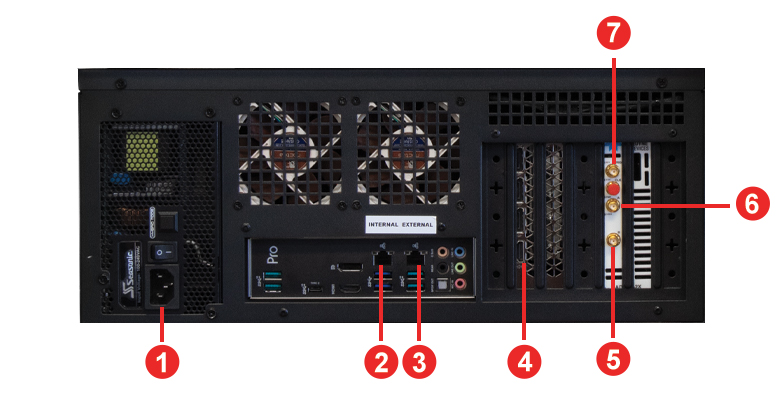
Click to Enlarge
Figure 3.10 IRsweep Acquisition Computer Back Panel

Click to Enlarge
Figure 3.9 IRsweep Laser Control Electronics Box Back Panel
| Acquisition Computer Back Panel | |
|---|---|
| Callout | Description |
| 1 | AC Power Input / Switch |
| 2 | Ethernet Bus for External Connection to Internet or Desired Network |
| 3 | Ethernet Bus for Local Area Network (LAN) Connect to Ethernet Switch |
| 4 | HDMI Display Port (Only Used During Certain Maintainance Operations) |
| 5 | Detector B Input (SMA Connector) |
| 6 | Detector A Input (SMA Connector) |
| 7 | External Trigger Input (SMA Connector) |
| Laser Control Electronics Box Front Panel | |
|---|---|
| Callout | Description |
| 1 | Remote Interlock Connector (Connect to Laser Safety Circuit or Close with a 50 Ω Impedance to Operate Lasers) |
| 2 | Laser Current Ouput to Spectrometer |
| 3 | Temperature Sensor Ouput to Spectrometer |
| 4 | TEC Ouput to Spectrometer |
| 5 | 12 VDC Output to Spectrometer |
| 6 | Ethernet 1 Connection to Ethernet Switch |
| 7 | Ethernet 2 Connection to Ethernet Switch |
| 8 | AC Power Input / Fuse Drawer / Switch |
Dual-Comb Spectroscopy Background Theory and Comparison to FTIR Spectroscopy
Dual-Comb Spectroscopy Basics
An optical frequency comb is a set of equally spaced narrow lines in the frequency domain characterized by the expression f (n) = f0 + nfrep, where f0 is the offset frequency, n is an integer, and frep is the frequency difference between adjacent comb lines and is equal to the pulse repetition rate. Frequency combs can be generated by a variety of pulsed laser sources, including QCLs, which have the advantage of being compact, solid-state sources that can emit in the mid-infrared region of the electromagnetic spectrum, which is why they are used in the exchangeable laser modules in our IRsweep spectrometers.
IRsweep dual-comb spectrometers are available in either amplitude-sensitive or phase-sensitive versions; the basic schematics are shown in Figures 4.1 and 4.2, with the main difference between the two versions being whether only one comb or both combs go through the sample. By superimposing two optical frequency combs with slightly different mode spacings, an optical absorption spectrum can then be transposed into the radio frequency regime through detection with a fast photodetector. The resulting heterodyne beating pattern in frequency space (labelled Down-Converted Frequency Comb in Figures 4.1 and 4.2) can be Fourier-transformed to recover the optical absorption spectrum, either just the amplitude or the phase and the amplitude, depending on the version of the IRsweep purchased.
In the amplitude-sensitive version, both combs are combined before going through the sample, providing the maximal sensitivity to amplitude changes in the light after going through the sample. However, it is insensitive to phase changes of the light after going through the sample. In the phase-sensitive version, only one of the combs goes through the sample, so the phase difference of the light due to the sample can be determined compared to the comb that did not traverse the sample. It is less sensitive to the amplitude than the amplitude-sensitive version, so if the measurement of the phase is unimportant, the amplitude-sensitive version will provide better measurement results. But for phase-sensitive measurements, such as measuring the group index and delay in structured media, such as aerogels, organics, or semiconductors, measuring path length sensitivities for gas expansion or compression, identifying mixed sample concentrations with overlapping spectral lines, or measuring the spectra of plasmonic nanomaterials or metamaterials, the phase-sensitive version would be preferred. Note that high-resolution mode is only available with a Stepsweep laser module that is only compatible with the phase-sensitive version.
Dual-Comb Spectroscopy Compared to Rapid-Scan and Step-Scan FTIR Spectroscopy
Dual-comb spectroscopy is advantageous compared to more common FTIR spectrometers because of its ability to achieve simultaneously high spectral and temporal resolution without any tradeoff. It measures the entire broadband spectrum of the combs at a resolution of at ~0.5 cm-1 in the timeframe of 1/Δfrep, which is ~4 µs in the IRsweep spectrometers, allowing for time-resolved spectroscopy on rapidly evolving samples or reactions, even when the dynamics are irreversible or non-periodic. It has no moving parts, unlike rapid-scan FTIR spectrometers, which use a fast-scanning mirror, which also have a much lower spectral and time resolution of ~16 cm-1 (0.48 THz) and ~10 ms. Step-scan FTIR spectrometers achieve higher spectral resolutions than rapid-scan FTIR of ~1 cm-1 (30 GHz) on average, but have been demonstrated down to 0.0007 cm-1 (50 MHz) in vacuum FTIR. Although step-scan FTIR is capable of achieving excellent time resolution with averaging of the time-resolved spectra from repeated measurements, it can take thousands of measurements to achieve this, which can take from hours to days to collect, depending on the resolution and signal-to-noise required, and it can't be achieved unless the process under study is repeatable.
The IRsweep phase-sensitive spectrometer with a Stepsweep laser module is capable of achieving spectral resolutions down to the linewidth of a single comb of ~0.0003 cm-1 (9 MHz) at the expense of slower acquisition times compared to standard resolution mode, but the acquisition is still much faster than a comparable measurement would be with a step-scan FTIR spectrometer. See Figures 7.1 and 7.2 in the Example Spectra tab for a methane sample spectrum taken in high-resolution mode.

Click to Enlarge
Figure 4.2 Phase-Sensitive Version: Only one of the frequency combs goes through the sample; the combs are combined after the sample and detected similarly to the amplitude sensitiver version schematic. The second comb acts as a reference, so one can simultaneously determine the effect of the sample on the amplitude and phase of the comb lines.
Click to Enlarge
Figure 4.1 Amplitude-Sensitive Version: Superimposing two optical frequency combs with different mode spacings and then sending them both through the sample. High-speed detection converts the optical spectrum to the radio frequency regime, thus recovering the optical absorption spectrum of the sample.

Click to Enlarge
Figure 5.1 The IRsweep spectrometer was designed to allow the dual-comb QCL laser modules to be swapped by the user in a fast and reliable fashion. The same spectrometer can be used with QCL modules of different center wavelengths, allowing spectroscopy across the full range of the available QCL center wavelengths, with the option of ordering custom QCL modules by sending an inquiry here.
IRsweep Spectrometer Operation Details
Module Replacement
The laser modules are replaceable, with four standard wavelengths available, in addition to the option of requesting custom wavelengths here. Figure 5.1 shows an image of the module being replaced by a user.
To replace the laser module, simply:
- Safely Switch off the Spectrometer
- Open the Laser Module Access Panel
- Remove the Coolant Connections to the Module
- Press Down on the Black Button at the Top of the Locking Latch to Release the Module (see Figure 3.6 in the Panels tab for its Location)
- Remove the Laser Module by Lifting Using the Black Handles
- Position the Replacement Module in the Bay, Using the Corner Brackets to Align it as you Lower it Into Position
- Press Down on the Black Button at the Top of the Locking Latch to Lock the Laser Module in Place
- Connect the Coolant Connections to the Laser Module
- Switch on the Spectrometer
- Adjust the Signal on the Detector, if Needed, by Rotating the Knobs on the Top of the Spectrometer (see Figure 3.3 in the Panels tab for their locations) that Rotate Polarizers in the Beam Paths (Neutral Density Filters may be used for Polarization-Sensitive Applications)
IRsweep Long-Term and Time-Resolved Acquisition Modes
The IRsweep spectrometer has two different acquisition modes with different purposes: time-resolved and long-term acquisition modes, shown schematically in Figure 5.2. In time-resolved mode, one single acquisition can be taken with a time resolution of ~4 μs per full spectrum (down to ~1 μs with post-processing), and a total length of up to 32 ms per acquisition, with the "Pre-Trigger" time being used to measure the background spectrum. Time-resolved mode is useful for spectroscopy measurements with rapid dynamics, where the spectrum is expected to change on the timescale of one acquisition. It would typically be used in combination with an external trigger source for the dynamics under study. Sequential repeated acquisitions can be used to build up the signal-to-noise ratio by averaging the repeated acquisitions.
In long-term mode, the measured sample spectrum is averaged over one full acquisition and the spectrum measurement is repeated at the acquisition frequency. The background is taken before the sample spectrum is measured, before the acquisition starts. Long-term measurements can go on for hours, as long as there is still space on the acquisition computer for the data, since the data is averaged before it is saved.
Another option is to take a high-resolution spectrum using our Stepsweep laser modules in combination with a phase-sensitive version of the spectrometer (see the Dual-Comb Basics tab for a description of each version and the Example Spectra tab for measurement results in this mode).

Click to Enlarge
Figure 5.2 The IRsweep has time-resolved and long-term acquisition modes, as shown in the top and bottom of the figure, respectively. In time-resolved mode the spectra are taken at ~4 µs resolution for the full acquisition time of up to 32 ms, after a pre-trigger measurement of the background spectrum, and the individual spectra are saved to disk. In long-term mode the spectra are still repeated at the ~4 µs time resolution, but the spectra in the acquisition time set by the user are averaged before they are saved to disk, which allows long-term measurements for hours without running out of disk space.
IRsweep Spectrometer Acquisition Software Screenshots
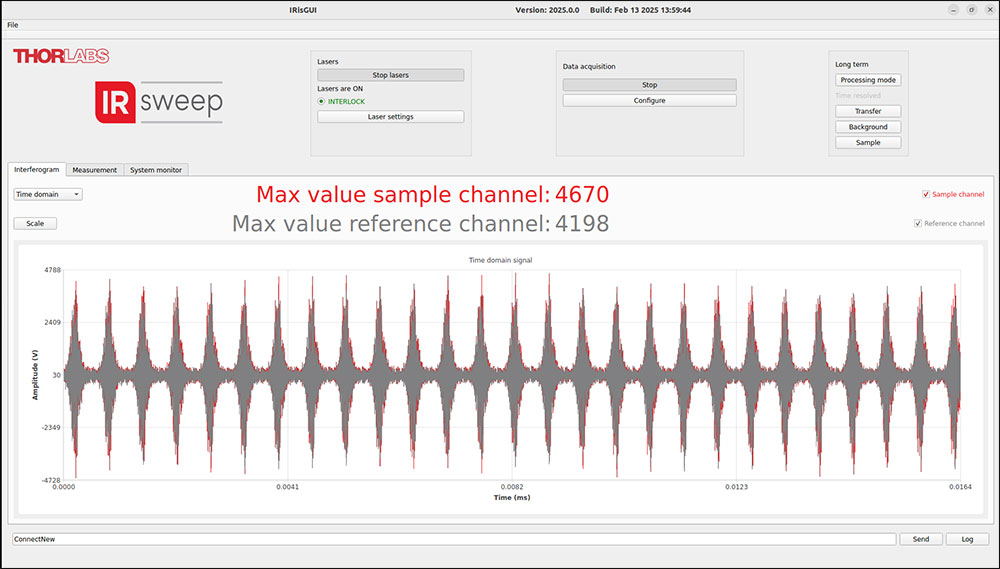
Click to Enlarge
Figure 6.2 IRsweep Spectrometer Software Screenshot:
Heterodyne Beat Signal in the Time Domain
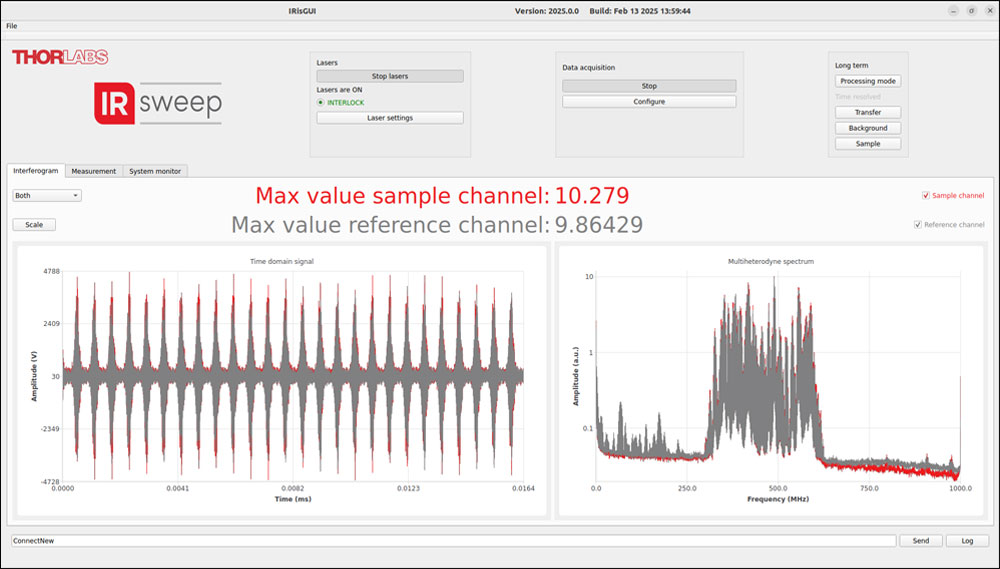
Click to Enlarge
Figure 6.1 IRsweep Spectrometer Software Screenshot:
Heterodyne Signal in the Time (Left) and Spectral (Right) Domains

Click to Enlarge
Figure 6.4 IRsweep Spectrometer Software Screenshot:
Long-Term Acquisition Mode Absorbance Data

Click to Enlarge
Figure 6.3 IRsweep Spectrometer Software Screenshot:
Heterodyne Signal in the Spectral Domain


Click to Enlarge
Figure 6.5 IRsweep Spectrometer Software Screenshot:
Time-Resolved Acquisition Mode Data Viewer
Sample High-Resolution Spectrum Taken with a Stepsweep Laser Module and a Phase-Sensitive IRsweep Spectrometer

Figure 7.1 An IRsweep methane spectrum was taken with a Stepsweep laser module with a phase-sensitive spectrometer in high-resolution acquisition mode. Note that HITRAN peaks missing in the IRsweep data may be due to lower laser power in that region of the spectrum. When ordering a laser module, we will work with you to ensure there is sufficient power to resolve the peaks of interest for your experiment.
Click to Enlarge
Figure 7.2 Zoom Into a Single Peak in IRsweep Methane Spectrum Showing a Gaussian Fit to the Doppler-Limited Peak (Wavenumber Axis Calibrated to HITRAN Data)
Published Methane Spectroscopy with IRsweep
The results from IRsweep high-resolution spectroscopy using a Stepsweep laser module to study the line shape parameters of CO2-broadened methane were recently publisheda.
- Jean Clément, Bastien Vispoel, Olivier Browet, Muriel Lepère, "Mid-infrared high-resolution dual-comb spectroscopy: Line shape parameters of CO2-broadened transitions in the ν4 band of methane," Journal of Quantitative Spectroscopy and Radiative Transfer, 432, 109501 (2025).
IRSweep Sample Time-Resolved 10 kHz Beam Chopper Data

Click to Enlarge
Figure 7.3 IRsweep Time-Resolved Acquisition Mode Single Spectral Line Data (10 kHz Beam Chopper in Sample Beam Path to Block/Unblock Beam)

Click to Enlarge
Figure 7.4 IRsweep Time-Resolved Acquisition Mode Full Spectrum Data (10 kHz Beam Chopper in Sample Beam Path to Block/Unblock Beam)
Published Gas-Phase and Biological Spectroscopy Using an IRsweep Spectrometer
Gas-Phase Spectroscopy
In reference a an IRSweep spectrometer in high-resolution mode using a Stepsweep laser module was used to measure the line shape parameters for methane, CH4. In reference e an IRsweep spectrometer was used to probe plasma-activated NH3 resolution of the rotational and vibrational states to quantify the state-specific number densities. In reference f time-resolved IRsweep spectroscopy was performed on the gases in a shock tube to achieve multi-species detection at high temperatures (>1000 K) and high pressures (>5 bar).
Biological Spectroscopy
In reference b the time-resolved mode of an IRsweep spectrometer was used and shown to be more sensitive and require less integration time when compared to Step-scan FTIR spectroscopy. In reference c time-resolved IRsweep spectroscopy was used to study the effects of sudden temperature changes on the folding dynamics of peptides. In reference d an IRsweep spectrometer was used to discover a new intermediate protein structure previously unseen due to the high temporal resolution needed to detect it.
- Clément, J., Vispoel, B., Browet, O., Lepère, M., "Mid-infrared high-resolution dual-comb spectroscopy: Line shape parameters of CO2-broadened transitions in the ν4 band of methane," Journal of Quantitative Spectroscopy and Radiative Transfer, 342, 109501 (2025).
- Klocke, J. L., Mangold, M., Allmendinger, P., Hugi, A., Geiser, M., Jouy, P., Faist, J., Kottke, T., "Single-Shot Sub-Microsecond Mid-Infrared Spectroscopy on Protein Reactions with Quantum Cascade Laser Frequency Combs," Analytical Chemistry, 90(17), 10494-10500 (2018).
- Mattes, L., Oestringer, M., Stritt, P., Horvath, R., Hugi, A., Hauser, K., "Temperature-jump QCL spectroscopy of peptide dynamics: expanding spectral accessibility by dual-combs," Chemical Communications, (2025).
- Norahan, M. J., Horvath, R., Woitzik, N., Jouy, P., Eigenmann, F., Gerwert, K., Kötting, C., "Microsecond-Resolved Infrared Spectroscopy on Nonrepetitive Protein Reactions by Applying Caged Compounds and Quantum Cascade Laser Frequency Combs," Analytical Chemistry, 93(17), 6779-6783 (2021).
- Sadiek, I., Fleisher, A. J., Hayden, J., Huang, X., Hugi, A., Engeln, R., Lang, N., van Helden, J.-P. H., "Dual-comb spectroscopy of ammonia formation in non-thermal plasmas," Communications Chemistry, 7(1), 1-10 (2024).
- Zhang, G., Horvath, R., Liu, D., Geiser, M., Farooq, A., "QCL-Based Dual-Comb Spectrometer for Multi-Species Measurements at High Temperatures and High Pressures," Sensors, 20(12), 3602 (2020).
| Posted Comments: | |
| No Comments Posted |
 IRsweep Spectrometers